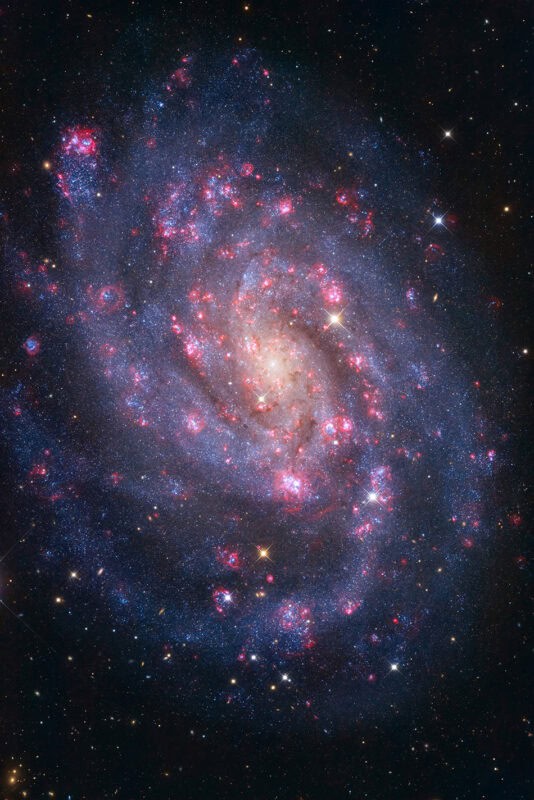
Celestial Antiquity NGC 300
NGC 300 (also known as Caldwell 70 or the Sculptor Pinwheel Galaxy) is a spiral galaxy in the constellation Sculptor. It was discovered on 5 August 1826 by Scottish astronomer James Dunlop. It is one of the closest galaxies to the Local Group, and it most likely lies between the latter and the Sculptor Group. It is the brightest of the five main spirals in the direction of the Sculptor Group. It is inclined at an angle of 42° when viewed from Earth and shares many characteristics of the Triangulum Galaxy. It is about 94,000 light-years in diameter, somewhat smaller than the Milky Way, and has an estimated mass of (2.9 ± 0.2) × 1010 M☉.
NGC 300 and the Magellanic type barred spiral galaxy NGC 55 have traditionally been identified as members of the Sculptor Group, a nearby group of galaxies in the constellation of the same name. However, recent distance measurements indicate that these two galaxies actually lie in the foreground. It is likely that NGC 300 and NGC 55 form a gravitationally bound pair.
The dwarf galaxy Sculptor C is located about 6.65 million light-years (2.04 megaparsecs) away from the Sun, and is very likely a satellite galaxy of NGC 300. Sculptor C has an absolute magnitude of about −9.1 which is typical for other recently discovered ultra-faint dwarf galaxies.