Celestial Antiquity GAL116
Creating a star is hard work, and the process is not very efficient. Current knowledge suggests that a stellar nursery must have a minimum density of gas and dust for a star to form. Only 1-2% of all the gas and dust in these clouds is utilised to ignite a star. But could even denser regions be more efficient at forming stars?
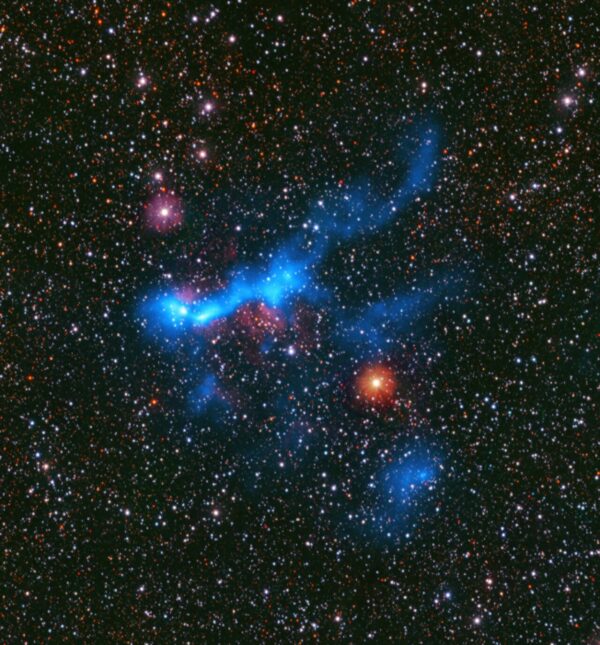
In today’s Picture of the Week, we’re looking at GAL316, one of the many stellar nurseries a team of astronomers observed to answer this question. This region is part of a survey called CAFFEINE – an astronomer’s best friend – carried out using the ArTéMiS camera at the Atacama Pathfinder Experiment (APEX), a radio-telescope in the Chajnantor plateau. Now operated by the Max Planck Institute for Radio Astronomy, this telescope captures the faint glow of cold gas clouds, seen here as a blue glow. This glow has been overlaid on a starry background captured with ESO’s VISTA telescope.
Results from the study show that, unlike astronomers, who get more efficient with a bit of caffeine, the densest regions observed with this CAFFEINE survey seemed no more efficient at producing stars than any other stellar nursery above the minimum density.