Celestial Antiquity HD 121617
Not all rings are forged in fantasy, my precious! For astronomers, they are found in space. The ones in today’s Picture of the Week are debris discs: the leftovers of planet formation around other stars.
Even our Solar System has a debris disc, known as the Kuiper Belt, where numerous asteroids and comets encircle the Sun beyond Neptune’s orbit. It is believed that the influence of large planets like Neptune prevented the dust and pebbles in this region from clumping together and forming larger bodies. Therefore, debris discs can be seen as remnants of planetary formation, and studying those around other stars is key to understanding the birth of planetary systems.
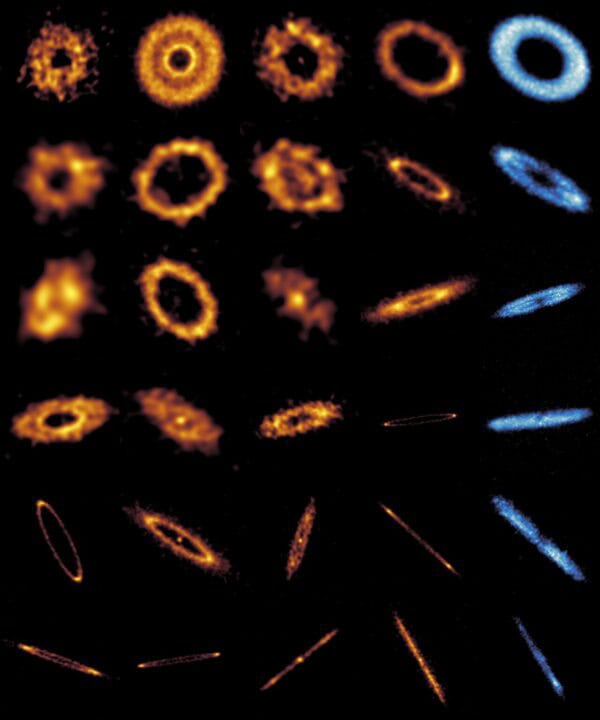
Using the Atacama Large Millimeter/submillimeter Array (ALMA), a team of astronomers has obtained high-resolution images of 24 debris discs around other stars. The orange images in this Picture of the Week show the distribution of dust in these discs, and the blue ones the distribution of gas in 6 of them.
The origin of gas in debris discs is debated: it could be leftover primordial gas that was present around the star from the beginning, or gas released later on as dust grains collided with each other. The debris disc around the star HD 121617, shown here in the two images at the top-right, is very interesting in this regard. The dust ring (orange) is brighter on one side, indicating a higher concentration of dust grains there. The team found that a vortex of gas could trap dust particles there, but only if the density of gas is very high. Such a high density of gas would be more consistent with this gas being of primordial origin. Further analysis of the full sample of debris discs will tell us more about the secrets of these precious rings.