Celestial Antiquity Ve 7–27
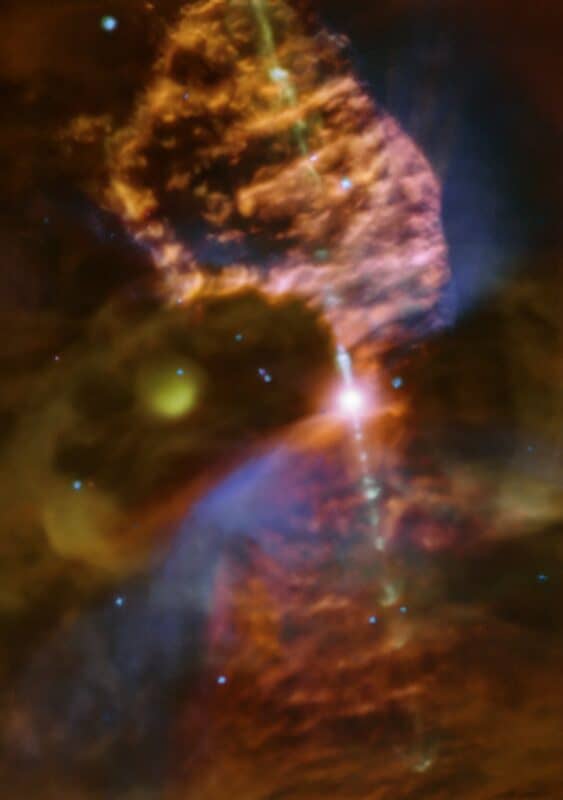
Today’s Picture of the Week represents an unexpected full circle moment. The depicted object, known as Ve 7–27 (RX J0852.0-4622 or G266.2-1.2), was long believed to be a planetary nebula — the end phase of a sun-like star’s life. But ESO’s Very Large Telescope (VLT) has shown that it’s actually a still-forming baby star.
For years the true nature of this nebula had been debated, but the VLT’s MUSE instrument has now captured the first detailed image of this object. It shows that Ve 7-27 is shooting energetic jets with knots or ‘bullets’ along them, which is typical for newborn stars. “Instead of being the “last breath” of a dying star, Ve 7-27 is a newborn one,“ says Janette Suherli, a PhD candidate at the University of Manitoba, Canada and first author of the study that revealed this surprising finding.
But there’s an actual dead star lurking just nearby. The compact yellowish-green smudge to the centre-left of this image hosts a neutron star produced when a massive star exploded as a supernova. This nebula is part of a larger cloud ejected by the explosion, the Vela Junior supernova remnant. The MUSE observations revealed that the baby star Ve 7-27 is embedded in the material expelled by this supernova. The distance to Vela Junior had never been precisely constrained before, but now we know this object is close to Ve 7-27. Since Ve 7-27 is known to be about 4500 light-years away, so is Vela Junior. Pinpointing the distance to Vela Junior means we now finally know its size, how fast it is expanding, how energetic it is, and how long ago the supernova exploded, solving decades of inconsistencies. The discovery therefore gives insights to not only the energetic baby star but also the true nature of Vela Junior and represents an “outstanding case of stellar birth and stellar death co-existing side by side in the same environment,” as Suherli describes.